Think Before You Speak

“The Pen is mightier than the sword.”

– Edward Bulwer-Lytton

It doesn’t take much to recognize the power of our words. We use them every day to communicate; we share our thoughts and feelings, we teach, and persuade. We can use our words to motivate and inspire, and we can use them to criticize and punish. Our words are critical tools for civilized society; so vital, in fact, that our founding fathers enshrined their unfettered use in the First Amendment of our Constitution.

With all this power, one would expect that great care would be taken to assure the proper use of the written/spoken word. Yet we’ve all been witness to the often cavalier manner in which some use their words. We can also emit some pretty harsh stuff in moments of anger or frustration.

We are warned that “words can cut like a knife.” Shouldn’t we, therefore, wield them with as much caution? Just because we can say something, doesn’t mean we should.

We’ve all been there; some of the most vicious animals on the planet are kids. They can say the most hurtful things to one another. While it generally starts out innocently enough, as they just don’t realize what they’re saying, they eventually fine-tune their craft. By the time they’re in middle school, they can be absolutely brutal. Nothing is off limits, as they ridicule their peers; hairstyle, body composition, complexion, fashion, and even your mom are all fair-game. (Just in case you’re wondering, back in the day, my dad could beat up yours.)

Most of us eventually grow out of this phase. We learn to recognize the social nuances of appropriate speech. We might “kid” our friends about their fashion choices, but that kind of discourse is reserved for personal time. Harassing your peers at work, or someone you hardly know about such things is a recipe for disaster.

Just as we teach the children in our junior’s program about the proper use of their jiujitsu and the responsibility which comes with it, so too, we want to teach them to navigate the social waters of appropriate speech. The tool we’re teaching them to use is the acronym THINK.

Before you speak, THINK…

  1. T – Is it True?
  2. H – Is it Helpful?
  3. I – Is it Inspiring?
  4. N – Is it Necessary?
  5. K – Is it Kind?

Unless you’re close friends with someone in class, your conversation should really be focused on the task at hand. While we’re on the mat, we should be focused on improving our jiujitsu, as well as our training partners’.

“If you don’t have something nice to say, don’t say anything.”

-My Mom

See you on the mat.

Back To School

“It is not the critic who counts; not the man who points out how the strong man stumbles, or where the doer of deeds could have done them better. The credit belongs to the man who is actually in the arena, whose face is marred by dust and sweat and blood; who strives valiantly; who errs, who comes short again and again, because there is no effort without error and shortcoming; but who does actually strive to do the deeds; who knows great enthusiasms, the great devotions; who spends himself in a worthy cause; who at the best knows in the end the triumph of high achievement, and who at the worst, if he fails, at least fails while daring greatly, so that his place shall never be with those cold and timid souls who neither know victory nor defeat.”

– President Theodore Roosevelt, April 23, 1910


Professor Cassio Werneck traveled all the way to Danbury, Connecticut this past weekend to compete in the Fight 2 Win 83. His dossier is packed full of accolades from over 20 years of competing. From Brazilian State Champion to Pan American Champion, and from World Champion To Masters’ World Champion, Professor Werneck has won them all. He could easily rest on his laurels, yet he continues to lay it on the line; rather than taking the easy path, he chooses to challenge himself again and again.

This is the indomitable attitude of a warrior. It is the willingness to push one’s self past the comfort of the known; it is the self-disipline to embrace the day-in, day-out grind of never-ending improvement. It is the internal fortitude to commit to excellence, even when surrounded by a society full of those who settle for mediocrity. A warrior chooses to strive for more; win, lose, or draw, they will know that they gave it their best.

As summer comes to a close many of us find ourselves shifting gears – children head back to school, and parents re-adjust their shuttle schedules. This can be a time of excitement, and of a bit of trepidation; children can be a bit intimidated by the prospects of new teachers, and moving up a grade. It is a great time to remind ourselves, as well as our children, of the power of accepting the challenge – just dive in.

  1. Based on past experiences, make a plan of action, and execute.
  2. Stay focused on the task at hand, the potential for victory, and the many benefits of success.
  3. Remember that stumbling, sometimes even failing in the attempt, is still an opportunity for learning and growth. Learn the lesson and move on.
  4. Surround yourself with a good team. Your family and friends should be like-minded and support your efforts

We should approach the rest of our lives just like we train in BJJ. Play all in; push past comfort zones – sometimes winning, sometimes losing, and always learning. In the end we will know we gave it all we had.

Let the nay-sayers worry about the risks from the side-lines.

See you on the mat.

Bad, And Getting Better

Do you feel the world is becoming more dangerous, that violence is on the rise, or that more and more people are dying from disease? You’re not alone. Every year since 1989 Gallop has asked Americans whether there’s more or less crime, and every year except 2001, the majority said it’s on the rise. Even though the statistics clearly prove otherwise, most feel the opposite. Americans aren’t alone; when polled in 2015 65% of British people (and 81% of the French) said they thought the world was getting worse.

If you find yourself in this majority, it’s time to change your focus, (check out last week’s post). By every metric of measure humanity has made, and continues to make, great headway in improving the lives of an ever-growing majority of the world population. Hans Rosling presents an enjoyable, easy-to-read argument in favor of a more realistic world-view in his book Factfullness: Ten Reasons We’re Wrong About The World – and Why Things Are Better Than You Think. He also has a number of great videos on Youtube; here’s one of my favorites.

Now this isn’t to say that everything is just fine. That would be as inaccurate as thinking everything is getting worse. We still need to remain vigilant; we face serious problems that require us to continue forging ahead as we work to find solutions. It’s simply acknowledging the reality – contrary to what the media and our politicians may tell us, things have improved drastically, and continue to do so. As Mr. Rosling points out in his book, we need to remember that

“…things can be both bad and better.”

This same mind-set can be helpful to the aspiring jiujitsu practitioner as well.

When we first start training BJJ everything is new, fresh, and invigorating. It’s easy to see our progress as we learn new techniques, and feel our bodies getting stronger. We see how much better we are than when we started. Over time, it can become more difficult to see our progress. Our perception shifts as we begin to realize how much more there is to learn. We can focus on our defeats, and lose sight of our victories. Our perspective can leave us feeling inadequate; compared to what’s possible, our BJJ is bad.

A key to the Jiujitsu Lifestyle is maintaining a healthy, optimistic perspective. If you catch yourself struggling with motivation, or feel like you’re just not making any progress, double check your perspective. Consider how much you now know compared to before you began. Remember that as long as you’re putting in your mat time, whether it’s two, three, or twelve classes a week, you are improving. Forge ahead having faith in the process. You can be both bad and getting better at the same time.

See you on the mat.

Hammers and Nails

“Sometimes you’re the hammer, and sometimes you’re the nail.”

Everybody who trains in Brazilian Jiujitsu gets it. There are those days when everything “clicks.” Our defense seems impenetrable, and our offense unstoppable. We are the hammer. Then there are those days when nothing seems to work. Our opponents pass our guard like the proverbial hot knife through butter, and we spend the day on the run, while fine-tuning our arsenal of various tap-outs. We are the nail.

This is the nature of Jiu Jitsu: we are continually pushing our limits, as we work to build a better, stronger self. In order to improve, we need to fine-tune our strengths and improve our weaknesses; we need strong partners to train with and put those skills to the test. Just as one needs both a hammer AND nails to build a house, we need to experience the full spectrum of training in order to build ourselves.

We learn to rejoice in our victories with a bit of gratitude and humility, while we accept our defeats with an appreciation for the learning opportunity it provides. In this regard, BJJ is analogous to our daily lives, in which we will experience both success and failure. We should enjoy the rewards of our successes, while being grateful for the people and circumstances that helped us get there. On the flip side, it’s important to remember that we can survive those times when things don’t go as planned; even when it seems our life is in a shambles, we can not only survive, but come out stronger. Often these lessons are the most empowering of all.

Whether you’re the hammer or the nail, embrace the grind. We’ll all be that much better because of it.

See you on the mat.

What Can You Do?

John F. Kennedy’s inaugural address is a highly motivational piece of our American history which you should read here: jfklibrary.org. (or watch it here) His is a great manifesto of Strength and Honor, praising the value of standing up for what’s right, even in the face of adversity. Perhaps the most well-known part of his speech is our focus this week.

And so, my fellow Americans: ask not what your country can do for you – ask what you can do for your country.

-John F. Kennedy

This admonishment applies just as well to those of us who might be too young to vote or have any comprehension of the politics of our day. It could just as easily read, “ask not what your family can do for you – ask what you can do for your family.”

As very young children, obviously our parents take care of everything. As we get older, we start to help out, and generally get assigned some “chores,” or responsibilities. Assuming my own childhood, and more recent experience as a parent are pretty common, this means that parents still spend quite a bit of time and energy reminding, cajoling, and/or bribing their progeny to clean their room. It is a sign our children are growing up when they start to accept their responsibilities, and perform their given tasks on their own accord.

At an even more mature level, a person identifies what needs to be done and takes care of it without guidance. Here is where asking yourself what you can do for your family comes into play. Develop the habit of looking at circumstances from the perspective of, “how can I help,” as opposed to “somebody else will take care of it.” This is about much more than just being helpful around the house. Having a proactive mindset is a key to success, as it leads to independence.

When faced with adversity, some people spend their time and energy blaming circumstances and others for their predicament. They also look to others for the solution, essentially behaving like a little child whose parents do everything for them. One thing that Brazilian Jiu Jitsu teaches us is that in the end, it’s up to us. Your professor can teach you the moves, your training partners can help you drill, but once you’re out there rolling, it’s all on you.

Is life much different?

Let’s teach our children to be independent thinkers – to be problem solvers. Let’s teach our children to “ask not what we can do for them, but what they can do for themselves.”

See you on the mat.

Crabs in a Bucket

While on family vacation in Santa Cruz with our Montana peeps, we’ve been enjoying the idyllic lifestyle that the area has to offer. In between hitting the rides at The Santa Cruz Boardwalk, watching the sailboats put in and out of Santa Cruz Harbor, and strolling along The Wharf, the days have been spent building sand-castles, body surfing, boogie boarding, and checking out tide pools at Natural Bridges State Beach.

The crabs, wharfs, and beaches, along with the broad swath of humanity here remind me of the “crabs in a bucket” metaphor. As the story goes, crabs collected in a bucket can’t escape because just as one reaches the top, the others drag it back down. It’s a vivid metaphor for human behavior driven by envy, spite, or competitiveness.

Our Brazilian Jiujitsu community is the exact opposite of this. Even though we’re engaged in a combative sport, in which we “fight” one another on a daily basis, it is a surprisingly communal effort. Our competitive training makes each of us better, and we push to improve ourselves as well as our teammates. We don’t envy other’s successes; we celebrate them.

Congratulations to all of the Werneck Family who’ve recently promoted. Your hard-earned successes are yours to enjoy. You know how hard you had to work, how much you had to sacrifice, to get where you are. We do too – so we’re celebrating your success with you.

belt promotions

See you on the mat!

The Coveted Black Belt

In the martial art industry, there is a very broad spectrum of what it means to be a black belt, and what it takes to achieve it. Time requirements range anywhere from as little as a few hours/week for two years up to  hours/day for a decade. Some schools require efficacy in sparring; many put more emphasis on katapoomse, or taolu. A student’s character, leadership, and “life skills” are also common qualifiers for black belt. Some systems award black belts regardless of age, while others reserve this rank for adults.

As should be apparent, this results in a tremendous range of skill and knowledge (or lack thereof) within the black belt community. The internet is packed full of video evidence to back up this claim. One can find videos of black belts performing amazing feats, and extraordinary fighting prowess, and black belts demonstrating skills that are, to put it kindly, less than awe-inspiring. This is a natural result of the vibrant diversity of our human condition and the free market.

But should it all be representative of being a black belt?

If everyone understood that a black belt was simply a level of achievement specific to the confines of a particular system, then such diversity wouldn’t be so problematic. However, that simply isn’t the case. As a social construct, Black Belt implies a certain level of expertise. According to dictionary.com, a black belt is “a black cloth waistband conferred upon a participant in one of the martial arts, as judo or karate, to indicate a degree of expertise of the highest rank.” Merriam-Webster says a black belt is “one who holds the rating of expert in various arts of self-defense (such as judo and karate).” 

Let’s be honest. People don’t aspire to be a black belt because it symbolizes “better than average.” They strive to be a black belt because it represents the highest level of achievement – as an athlete, as a martial artist, as a human being, and as a leader.  They want to be a black belt because it represents expertise in the art of kicking butt.

Consider this.

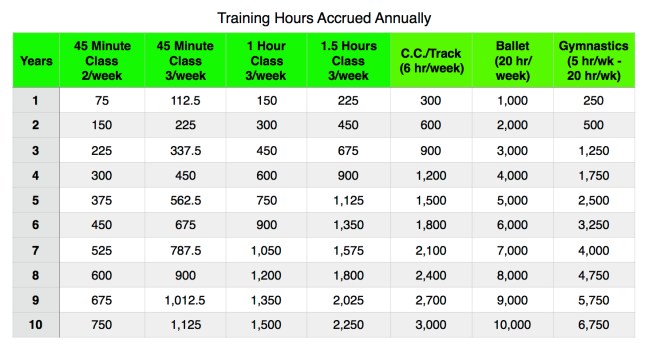
Each of my three daughters has their passion: one loves to run, one loves to dance, and the third loves gymnastics. Each has the same choice to make in pursuing these activities: is it a recreational hobby, or are they going to pursue EXCELLENCE? Each can choose to dabble in their “art” a few days a week. The runner can go out and put in her miles at her leisure, while the other two can attend recreational programs for just this purpose. Over time all three will reap the many benefits that come from such participation. However, at these levels, they will NEVER become experts in these endeavors.

The runner puts in 1+ hours of training six days a week during the on-seasons for high school track and cross-country, and tapers to an hour/day in the off-season. Experts in these fields train/compete through high school and college, which works out to around eight years. Then they put in additional time getting a degree or certification in order to coach. The ballerina puts in 20+ hours/week at the studio during the school year, and does an annual three-week intensive (six hour days/six days/week). By the time she’s considered an expert, she will have been training in this manner since sixth grade. The gymnast is currently just recreating a couple times a week. If she decides to pursue it, the competition team starts out at about 5 hours/week for her age, and builds up from there.

annual training comparison

The average karate/taekwondo school utilizing the standard twice a week, 45-minute class structure promotes students to Black Belt in three years. Throw in six months of Saturday morning intensives, and it’s still less than 500 hours total. Compare that to the 2,250 hours in Brazilian jiujitsu (1.5 hours @ 3/week for 10 years), the runner’s 3000, the gymnast’s 6,750, or the ballerina’s 10,000!

There’s nothing wrong with training martial arts a couple times a week. It’s a fun way to stay active, fit, and learn some cool stuff.  Just don’t confuse recreation with expertise. If  you seriously want to be a Black Belt, you can make it happen –  you’ve just gotta be willing to put in the work. Next week we’ll discuss our Brazilian Jiujitsu belt system, to give you a better idea of what it’s going to take.

See you on the mat.

Why My Daughters Train in BJJ

I am a father trying to do right by my children.

As parents, we want what’s best for our children. We do everything we can to make sure they’re loved, well fed, and have a roof over their head. We’re preparing them to be successful adults. We sign them up for gymnastics, music lessons, soccer, martial arts, little league, science camp, ballet, cheer, and swimming. We try to support and nurture their individuality when it’s in their best interest, but as the adult in the room, we’re left in the driver’s seat, and have to decide when it’s not.

Trying to sort through all these options and pick the best can be challenging. In addition to simple recreation, we look for the benefits; will this help my child be more fit, develop greater self esteem, or learn the value of teamwork? Part of our decision is based on the logistics of somehow getting to and from, in between school, work, and family time. Part of it is financial. While we’d love to give our progeny everything, the bottom line is, we are inevitably limited; there are only so many hours in a week, and only so many dollars in our wallets.

I am a martial artist biased by 35 years training, studying, and teaching.

I believe that martial arts is a “package deal,” providing a one-stop shopping experience for parents. When taught effectively, it is powerfully transformative, developing strength, flexibility, and cardio-vascular fitness, while also promoting valuable life lessons like integrity, self discipline, respect, focus, tenacity, and self esteem. A good martial art program can also provide it’s students with something other activities most definitely do not: self-defense. This full-package should make martial arts especially appealing to parents struggling with the decision of where to enroll their children.

There is one caveat, however: not all martial arts are taught effectively, and thus do not live up to the promise. Self-defense is one area in particular, where many programs fall short. It is a messy affair, and has much more to do with a state of mind than fancy techniques. An individual must be able to function under duress, and have an effective arsenal that will work consistently. To develop this a student needs to train in combat conditions regularly and consistently. It is simply not feasible for the general public to engage in full-contact sparring on a regular basis. Given the current awareness of the detrimental, long-term effects of repeated head trauma, the problem with children regularly punching and kicking one another in the head should be apparent.

However, in Brazilian Jiujitsu (BJJ), we can safely “roll” (spar) in every class. We learn a multitude of techniques, and have the regular opportunity to apply them against  opponents of varied shapes, sizes, and skill. This hones the fundamentals of BJJ, as well as our own individual “game.” These fundamentals work, regardless the circumstances. A smaller, weaker individual really can learn to control a larger, stronger aggressor. The intensity of this phase of training develops the mental fortitude that enables us to remain “calm” under pressure, to be able to fight through and survive often uncomfortable, seemingly untenable conditions. In this manner, our skills and our mental tenacity are forged in the fires of combat.

I am a biased father who’s daughters will be well-prepared for all of life’s challenges.

My oldest daughters have discovered their passions. (the jury’s still out for the third) Between school and pursuing these, there is little time left for martial arts. It’s currently my job to protect them, but that responsibility is quickly becoming their own. Brazilian Jiujitsu provides them the training they need, in the limited amount of time they have, to become sufficiently well-prepared for the unlikely specter of violence.

For most of us, the odds of being the victim of violence are small. (here’s some perspective) Indeed we’re much more likely to die in an automobile accident, or of heart disease, than to die from a violent crime. Just like those examples, we can improve our odds by being smart about the risks, and developing good habits – prevention truly is the best medicine. As discussed last week, while avoiding violence altogether is our best bet, given it’s critical nature, it only makes sense to be prepared for it none-the-less. The question we must ask ourselves is one of resource allocation. That is, how much time and energy should we devote towards preparing ourselves and our children?

See you on the mat.

Why My Girls Train in Martial Arts.

One of my training partners recently published an insightful post on Facebook that does a great job reiterating my feelings as a martial artist and a father. As a Law Enforcement Officer, his perspective is further sharpened by the realities of the world in which we live.

“My son, due to his age, has been doing BJJ off and on since he turned five – so much so that when he starts again it’s basically brand new.  Last week I took him to class and needless to say it’s been a while. Toward the end of class he was rolling with another kid and got his back taken, ending up face down on the mat. Not knowing what to do and in a panic he yelled, ‘daddy help me.’

It has been a week and that yell is still fresh in my mind, and gets replayed over and over again. It’s a different type of scream when your kid is in trouble, and it hits you at your core. I can only imagine if it were a real life event with drastic implications. I’ll be the first to say BJJ or any type of martial arts is not the end-all-be-all, but I would be devastated if my son or daughter screamed those final words without giving him or her a fighting chance.

I’ve seen a lot of victims in my life – most made it, some didn’t – and I wonder if those were their last words towards the end.

I understand my career gives me a skewed view on life, but trust me it’s better to be prepared then not. Empower your kids at a young age so they have a fighting chance later on in life. I know of a few places to sign your kids up to train.”

As a former part-paid fireman, I am well aware of the risks we face in the home. We take all appropriate precautions, avoid over-loading extension cords, keep the clothes-dryer duct clean, and wash the exhaust fan filters over the stove monthly. The odds of ever having a house fire are slim. Nonetheless, we have smoke alarms throughout the house, and a fire extinguisher in the kitchen. The children have been taught and practiced various evacuation plans in the event of a fire.

In this same spirit, they are learning how to defend themselves as well. They are taught the risks, steps to take to avoid problems, as well as how to fight if they must. If they make good choices and pay attention, they will probably never need the fire extinguisher, nor will they need to fight.

The bottom line is, we live in a pretty safe time and place here in the good ol’ U.S. of A. Violent crime has been declining since the early 1990’s, even with the slight upticks the last two years. (Sadly, those increases were due to specific neighborhoods in specific cities!) With a little bit of prevention – being educated on the actual risks, and staying aware of our surroundings – we can all but eliminate the chances of experiencing violence and the need to defend ourselves.

While the odds are nothing will happen, it is critical than one be prepared in the event that it does. Another friend once made this comparison –

“Our need for a car is common, but it isn’t critical. We use them all the time, but if push comes to shove, we can find another way to get around. The need to defend ourselves isn’t common, but it is critical, for when it comes to violence, it is the only difference between being the victor or the victim.”

The skills we need to defend ourselves, to give ourselves a fighting chance in the most dire of circumstances, require a bit of time and effort to acquire. Due to the low risk, most people don’t even consider this investment. Just like a fire extinguisher, we rarely see the need. Given the critical nature of violence, however, don’t you think it’s worth it?

See you on the mat.

What? I can’t hear you…

The Yin and the Yang – we’ve all seen the image; two interlocking circles appear to flow into one another, and at the same time are part of a larger circle. The Chinese Taijitu (太极图) dates back over a thousand years to the Song Dynasty.Yin yang

In the 1880’s what Koreans call Taegeuk (태극) was adopted into the South Korean National Flag.Flag of South Korea

Even as a little kid growing up in the far reaches of small-town Montana I had seen this symbol. It was on the box cars and cabooses of the Northern Pacific Railroad which ran near my house.Northern_Pacific_Railway_Logo,_November,_1952

One doesn’t have to be a Daoist to appreciate the meaning of the symbol. What a simple, yet powerful image of integrity – of “being whole and undivided,” or “being unified or sound in construction.” (Oxford Dictionary) The two opposing colors flow from, and into, one another, thereby creating the whole. Take away either part and you’re left with an incomplete, dysfunctional package. Imagine it as a tire on your car and you get the idea.1:2 yin:yang As Brazilian Jiujitsu practitioners, we’re continually working to refine our skill set. We learn offensive (yang) and defensive (yin) techniques. We also have to continually modify our “game” as we train with a diverse group of teammates. One can’t use the same strategy against a smaller, faster opponent that might be effective against a larger, stronger opponent. We must develop multiple “sides” to our game if we wish to be the best we can be.

“Don’t say things. What you are stands over you the while, and thunders so that I cannot hear what you say to the contrary.” – Ralph Waldo Emerson

Just as we work to round out our BJJ game, we should work to have integrity as a human being as well. Just as the Yin/Yang symbol is a combination of all it’s parts, we too are a product of all our parts. Our words should be consistent with what we think, otherwise, we’re simply lying. Our actions should match our words, or else we’re hypocritical. Our thoughts should be reflected in everything we say and do. In this manner, we strive to maintain our integrity.integrityvenndiagram

Ol’ Ralph W. Emerson got it right.

See you on the mat.