On The Shoulders of Giants

“I must study Politicks and War that my sons may have liberty to study Mathematicks and Philosophy. My sons ought to study Mathematicks and Philosophy, Geography, natural History, Naval Architecture, navigation, Commerce and Agriculture, in order to give their Children a right to study Painting, Poetry, Musick, Architecture, Statuary, Tapestry and Porcelaine.”

-John Adams, 1780

As a parent, I’ve come to a greater appreciation for the sentiment in John Adams’ letter to his wife.  We do what we must to provide a good life for our children, and we try to give them more than we had, just as our parents did for us, our grandparents did for them, and so on back through the ages. With a little historical perspective we see that humans have been highly successful. Historical perspective also helps us not lose sight of the traits that led to that success.

Since the 18th century, life has gotten better. The global life expectancy has more than doubled – from around 30 years to nearly 70. Literacy rates exploded from under 20% to almost 100%! A little closer to home, consider the early pioneers of this country. Our trials and tribulations pale in comparison to the hardships they faced as a matter of course. Imagine what the Donner Party would think of Interstate 80 today; 30,000+ vehicles cross over the Sierra-Nevadas without incident almost every single day. Through scientific understanding, technological advancement, democratic institutions, and free-market economics we have transformed our world into a much more hospitable one.

Surely we have achieved what John Adams aspired to. Current generations now have the luxury to study “Painting, Poetry, and Musick.” We also have immediate access 24/7 to safe drinking water, flush toilets, medicine, and just about every food imaginable. Indeed, most of us are so far removed from any real struggle, that it’s easy to take what we have for granted.

The conveniences of our modern life allow us to become soft and weak. This is why training in a martial art like Brazilian Jiujitsu is so important. BJJ is the perfect activity for helping develop and nurture strength and resilience of mind, body, and spirit. On the mat we learn to push our limits, to remain calm under pressure, and to be comfortable with the uncomfortable. We learn to accept defeat as an opportunity for growth, and to be gracious in victory. BJJ conditions us to be hard and strong.

“We [the Moderns] are like dwarves perched on the shoulders of giants [the Ancients], and thus we are able to see more and farther than the latter. And this is not at all because of the acuteness of our sight or the stature of our body, but because we are carried aloft and elevated by the magnitude of the giants.”

attributed to Bernard of Chartres by John of Salisbury

As we enjoy the benefits of the world past generations helped create, it’s important that we do not lose sight of their accomplishments, and the hardships endured to get to where we are. We must be diligent in passing onto our children an appreciation of what it means to live in this era, to have gratitude for all that they have, and to value the traits that enabled our ancestors to get us here. That past should stand as testament to the strength and resilience that lies within each of us. Indeed, our children have the right to study the arts, but not at the expense of mathematics, science, or philosophy. They must also study history, politics, and war, in order to continue the tradition of passing on a better world to the next generation.

See you on the mat.

You Are Not Just a Rock

“Like a rock, I was strong as I could be,
like a rock, nothing ever got to me,
like a rock, I was something to see.
Like a rock.
Like a rock, standing arrow straight,
like a rock, charging from the gate,
like a rock, carrying the weight.
Like a rock.”

-Bob Seger (1986)

We admire rock. We use it as simile and metaphor throughout literature, from the old testament, “Ascribe ye greatness unto our God. He is the Rock, his work is perfect,” (Deut 32:3-4), to a cheesy ad in a fitness magazine for “rock-hard abs,” to Bob Segers’ pop hit, “Like a Rock.” Rock symbolizes strength, steadfastness, and honor. To be like a rock is to be reliable, consistent, and resolute in conviction.

Of course, there is a downside to being a rock. Nobody aspires to be as “dumb as a box of rocks.” Rocks are inflexible and extremely slow to change or adapt. Such rigidity is the antithesis of one of our most powerful human traits – our amazing capacity for growth.

“To improve is to change; to be perfect is to change often.”

-Winston Churchill

Nowhere is the capacity to grow more apparent than in the world of sports. World-class athletes, regardless their area of expertise, are shining examples of this. It is a common misconception that world-class athletes are simply gifted – the fortunate recipients of gifts endowed upon them by fate, or more scientifically speaking, good genes. Such “gifts” can only take one so far, however. In the final analysis, the commonality among world-champions is not having won the genetic lottery, but having the ability to improve.

Basketball’s Michael Jordan is a perfect example. Considered by many to be the NBA’S GOAT, anybody old enough to remember knows of his accomplishments on the court. What many are not aware of, is all the work he put in off the court. As a sophomore in high school he was initially deemed too short to play varsity. Rather than quit, he used that to motivate himself. “Whenever I was working out and got tired and figured I ought to stop, I’d close my eyes and see that list in the locker room without my name on it,” Jordan would explain. “That usually got me going again.” (Newsweek 2015) Regarding Jordan’s work ethic, Chicago Bulls coach Phil Jackson wrote,

The thing about Michael is, he takes nothing about his game for granted. When he first came to the NBA back in 1984, he was primarily a penetrator. His outside shooting wasn’t up to pro standards. So he put in his gym time during the off-season, shooting hundreds of shots each day. Eventually, he became a deadly three-point shooter.

Playing outstanding defense didn’t come automatically to him, either. He had to study his opponents, learn their favorite moves and then dedicate himself to learning the techniques necessary to stop them. He’s worked extremely hard to perfect his footwork and his balance.

Nowadays, so many kids come into the league with arrogant attitudes, thinking that their talent is all they need to succeed. By contrast, there’s a certain humility in Michael’s willingness to take on the difficult work of making himself a more complete player. For me, one of the signs of Michael’s greatness is that he turned his weaknesses into strengths.”

Through proper training, we can become faster, stronger, and more agile; we can continually develop an ever increasing level of skill, and become more in-tune to the nuances of the game, whether it’s basketball, Brazilian jiujitsu, or life.

This capacity for growth isn’t restricted just to our physical selves. It’s important to remember that we have just as much ability to improve ourselves mentally and emotionally. We need to nurture what Stanford University psychologist Carol S. Dweck calls a growth mindset, and reject the fixed mindset – the belief that ability is static(Dweck, 2016)

With a growth mindset we acknowledge our potential. We don’t fear challenges, but see them for the opportunity they represent. Through the proper effort, we can deal with what life throws at us, and continually grow in the process. We can build our bodies and our minds. In this manner, we are not so much like a rock, but more similar to a plant. We continually grow stronger, adapting to the conditions of the world around us.

See you on the mat.

Dweck, C. (2016). Mindset: The New Psychology of Success. New York, NY: Ballantine Books

Jackson, Phil (June/July 1998) Michael and Me. Retrieved from http://www.nba.com/jordan/is_philonmj.html

The Remedy to the Bully Epidemic

As we close out October, and National Bully Awareness Month, we get to wrap up this bullying series on a high note. Repeat after me: “there is no epidemic.” The children of today are no more evil, nor ill-intentioned, than they were when we were kids. No matter how many websites quote horrific stats as to how bad the problem is, remember these numbers are not based on an increase in peer aggression and negative behavior in children, but are due to an all-encompassing expansion of the definition.

As parents and educators, we need to distinguish between very real dangers, such as automobile accidents and drowning, and the pain and anguish caused by less-than-pleasant phenomena of childhood: peer aggression, teasing, taunting, name-calling, and social exclusion. The former can lead to dismemberment and death, whereas the latter, although unpleasant, are mostly benign.

Rather than treating these as threats to our children’s well-being, we need to recognize them as opportunities for growth; these teachable moments present the perfect opportunity to help our children realize their personal agency, and their resiliency. We must remember this is a long, complicated process. Children are still developing their understanding of the nuance of body language, intonation, inflection, humor, sarcasm, and timing. They’re still learning how to filter what they say, consider other’s feelings, and how to follow the rules. In fact, the areas of the brain responsible for cognition, following rules, suppressing impulses, reasoning, and decision making are still developing as well.

If we’re serious about helping our students, we must stop type-casting the players. The current bully-victim-bystander model stands in the way of all this development. It reinforces roles which assume intent on the part of the bully, and a victimhood mindset on the part of the target. Neither of these fixed mindsets is conducive to learning and growth. We should be helping students adjust behavior, but we can’t effectively address the various behaviors when they’re all lumped under bullying. We need to more effectively delineate the pathology of bullying, and the common childhood phenomena of peer aggression, impulse control, teasing, etc. Then we can teach our children effective means of dealing with each. For these reasons, the bully-victim-bystander model should not be used in an educational (K-12) setting.

We should be teaching our students that they and their peers have the capacity to  grow and learn, to be better versions of themselves every day. They can learn better communication skills, become more civically minded, and develop a deeper sense of empathy. They can increase their self-control, self-esteem, and learn to defend themselves. These are the tools that will enable them to deal with all the trials and tribulations of childhood, and to thrive as adolescents. All they require is guidance, experience, and time.

“Good judgment comes from experience and experience comes from bad judgment.”

-Anonymous

We need to remember that just like BJJ, our ability to get along with others, communicate our ideas, and understand others’ intent takes years of “mat time.” Children can be given instruction on the rules, and taught different methods of dealing with the most common issues. However, we have to remember the majority of learning and understanding comes from actual application. This means there will be successes and failures, they’re going to make mistakes – they will offend and be offended, insult and be insulted, hurt others’ feelings and have their’s hurt. As we continue to coach in between rounds, they will gradually gain an ever-better understanding of the full spectrum of human interaction. They will gain the skill, and the strength to succeed.

See you on the mat.


Best, J. (1990). Threatened Children: Rhetoric and Concern About Child-Victims. Chicago, IL: The University of Chicago Press

Dweck, C. (2007). Mindset: The New Psychology of Success. New York, NY: Ballantine Books

Haslam, N. (2016). Concept Creep: Psychology’s Expanding Concepts of Harm and Pathology. Psychological Inquiry, 27(1). Retrieved from: https://papers.ssrn.com/sol3/papers.cfm?abstract_id=2690955

Porter, S. (2013). Bully Nation: Why America’s Approach to Childhood Aggression is Bad for Everyone. St. Paul, MN: Paragon House


Don’t Throw The Baby Out With The Bathwater

With October we’re witnessing the transition to fall. Cooling temperatures bring about change, as green turns to gold, brown, and crimson, and we ramp up for the upcoming holiday season. The kids are plotting their Halloween costumes, as parents finalize plans for Thanksgiving and the Christmas season. October is also National Bullying Prevention Month, therefore we will be discussing various aspects of bullying over the next five weeks.

In his paper Concept Creep: Psychology’s Expanding Concepts of Harm and Pathology, Nick Haslam discusses how concepts like bullying have been expanded to “encompass a much broader range of phenomena than before.” They are extended outward to include new phenomena and downward to include less extreme phenomena. Potential benefits of such expansion include recognizing formerly tolerated negative behavior as problematic, and increased sensitivity to others suffering or maltreatment. The cost of this creep, however, may very well create more problems than it fixes.

Some Bullies tease, but not all teasing is bullying.

Teasing is one of the casualties in the ever-expanding definition of Bullying. The two are often used synonymously in the media and much of the available “anti-bully” literature. This semantic overlap has led to much confusion and mis-information for parents. It is also a headache for teachers and school administrators. As they work to establish legally mandated “learning environments free from distractions,” they create so-called zero-tolerance policies regarding bullying. In other words, NO TEASING ALLOWED.

There is an extensive body of academic literature studying the many cultural facets of teasing and it’s beneficial role in human communication. As explained by Kruger, Gordon, and Kuban (2006),

“To be sure, some teasing is designed with the sole purpose of hurting, humiliating, or harassing the target of the tease. But often, individuals tease to flirt, socialize, play, enhance social bonds, teach, entertain (themselves, the target, or an audience), or to express affiliation, affection, and even love (p. 412).”

In The Good, the Bad, and the Borderline: Separating Teasing from Bullying (2009), Mills and Carwile thoroughly discuss teasing, it’s relationship to bullying, and it’s value as a communicative device. While teasing can be used by bullies in a negative, aggressive manner, teasing also plays a very beneficial roll in our interpersonal interactions.

Teasing is very nuanced, utilizing humor, innuendo, sarcasm, and irony to indirectly communicate the intended message. Even as adults we oftentimes misinterpret the intent of someone’s witty or sarcastic quips. How can our children grow into strong, high-functioning adults, if they aren’t given the opportunity to develop this skill?

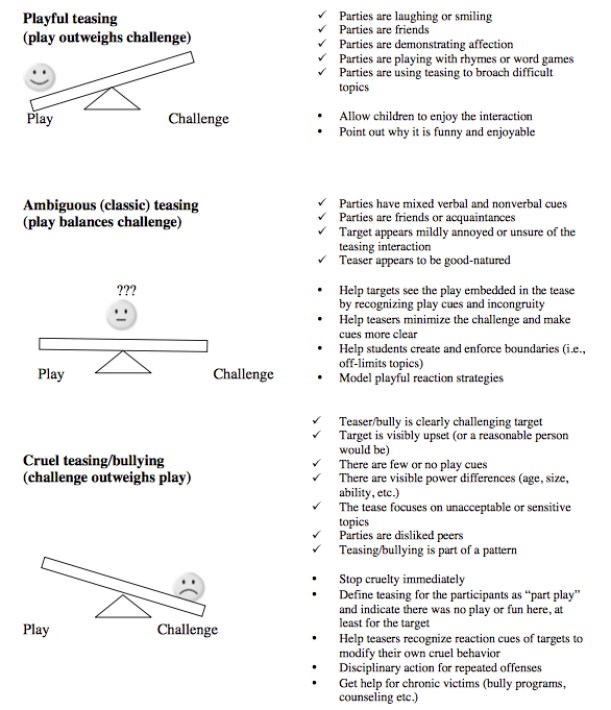
Mills and Carwile provide the Teasing Totter model to help those who would try to teach children to discern between the varying degrees of appropriate, healthy teasing. For a more in-depth look click here.

Teasingtotter

Rather than eliminating all forms of teasing in a misguided attempt of protecting our children, as parents and educators we need to do the hard work of distinguishing between the positive, beneficial forms and the negative. We need to allow children the opportunity to fine-tune these skills themselves, and help guide them through the sometimes murky waters of human communication. This understanding will make them stronger, more resilient, and more safe, enabling them to more effectively discern healthy human interaction from the threat of a bully. Otherwise, we’re just throwing the baby out with the bathwater.

See you on the mat.

image credit: stopbullying.gov


Haslam, N. (2016).  Concept Creep: Psychology’s Expanding Concepts of Harm and Pathology, Psychological Inquiry, 27(1). Retrieved from: https://papers.ssrn.com/sol3/papers.cfm?abstract_id=2690955

Kruger, J., Gordon, C., & Kuban, J. (2006). Intentions in teasing: When ‘‘just kidding’’ just isn’t good enough. Journal of Personality and Social Psychology, 90, 412􏰀425.

Mills, C. B. (2009, April). Communication Education. Retrieved from: https://www.researchgate.net/profile/Carol_Bishop_Mills/publication/263612607_The_Good_the_Bad_and_the_Borderline_Separating_Teasing_from_Bullying/links/58a72725a6fdcc0e078ae9c7/The-Good-the-Bad-and-the-Borderline-Separating-Teasing-from-Bullying.pdf

Not Fine China

Let’s face it, life here in the burbs of NorCal is pretty sweet. We are lucky to be raising our children in a time and place where they are unbelievably safe, and it keeps getting safer, despite what the media would have you believe. While all the improvements we’re witnessing are good news, I fear that in an overzealous attempt to guarantee their safety, we are actually putting our youth in harm’s way. Is it possible to be too safe?

“Why then, can one desire too much of a good thing?”

-Shakespeare, As You Like It

Why yes, William, one can have too much of a good thing. Take water for example – it’s not only good for you, it’s vital; we require water to survive, and many should drink more than they currently do for optimal health. Yet too much water is more than a little problematic; water intoxication (hyponatremia) can be fatal. So can drowning.

In this same fashion, the “better safe than sorry” mantra has been taken to an extreme. Our parks have rubberized crash pads under age-appropriate play structures, with nary a treacherous teeter-totter nor merry-go-round in sight. Even with all of this benign safety equipment, there’s always a parent near-by, hovering about like a helicopter from the local news station, waiting to jump in at the first sign of danger. Children rarely walk, or ride their bikes, to school. When I do see them biking, they look geared up for battle – not only sporting a helmet, but also wrist braces, and elbow & knee pads. Once at school, they’re not allowed to play freeze tag or dodgeball for fear someone might get hurt. Just like the public swimming pool, it’s become the land of NO: no running, no diving, no chicken fighting, no pushing, no this, no that, no…..

The teachers and/or parents always hovering nearby are also the new arbiters of all that is right. Not only are we making sure nobody gets physically injured, it is now of vital import that nobody’s feelings get hurt either. Anytime there’s a bit of disagreement, there’s an adult ready to jump in and straighten it all out. Read your local school board policy and you’ll note an emphasis on students’ feelings of safety.

“What doesn’t kill me makes me stronger.” 

– Friedrich Nietzsche

In our pursuit to shield our children from any and all physical, emotional, and mental distress, we are also removing valuable opportunities for them to develop into strong individuals. Bumps, bruises, and hurt feelings (gasp!), are all very real, and vital components of children at play. These are opportunities for our children to develop better risk assessment, become more independent, learn to fall and get back up, and fine-tune their conflict-resolution skills. Perhaps most importantly, they will realize that their bodies, as well as their feelings, will not only heal, but be that much stronger because of it.

In his book Antifragile: Things That Gain From Disorder,  author Nassim Nicholas Taleb asks us to think beyond fragility and resilience, and recognize that some things are antifragile; they need to be stressed and challenged in order to adapt and grow. The fine china we received from my in-laws is fragile; it breaks easily, and can’t heal itself. The plastic cups our daughters used as toddlers are resilient; they take a beating and remain relatively unchanged. We need to think of our children as neither fragile nor merely resilient – they are antifragile. Just like our muscles, bones, and immune system, our children get stronger when faced with challenges.

“Thus, when Heaven is about to confer a great office on any man, it first exercises his mind with suffering, and his sinews and bones with toil. It exposes his body to hunger, and subjects him to extreme poverty. It confounds his undertakings. By all these methods it stimulates his mind, hardens his nature, and supplies his incompetencies.”

– Mencius,  4th Century BCE

This is the nature of training in jiu jitsu. We are continually putting ourselves under pressure – the pressure of combat, in order to become physically, mentally, and emotionally tougher. BJJ students are antifragile; we are not made of fine china.

See you on the mat.

The Power of The Tap

Training in BJJ can oftentimes seem a bit of a paradox, especially to the uninitiated. We train for fun, and improved health, to develop self esteem and confidence, by getting smashed, arm-barred, and choked by our training partners. Indeed, many of us often wonder ourselves, as we head to the next class with a slight bit of trepidation. Yet we always leave said class feeling better than ever, supremely grateful for the training, and looking forward to the next.

This seemingly paradoxical nature of BJJ is embodied in the tap. We “tap out” when our training partner achieves a successful joint lock or choke, at the verge of damaging a joint or rendering us unconscious. Tapping out is a safety valve which enables us to train in the most realistic manner possible; we can utilize destructively effective techniques while simultaneously maintaining a safe training environment.

The last part of class is reserved for some form of rolling, where we have the opportunity to apply our skills against an “opponent.” Here we come face-to-face with the exquisite nature of BJJ. While we are are engaged in fierce competition with our opponent, each trying to get the tap by submitting the other, we are also trying to learn, and help our training partners do the same. If we train solely to win, we let our ego get in the way of learning. We tend to be too rigid, relying on our strengths, and thus not growing. We need to be more fluid in our rolling, more willing to try new things and make mistakes, and therefore more willing to tap. It’s helpful to remember the admonishment…

“There is no losing in jiujitsu. You either win or you learn.” – Carlos Gracie, Sr.

As Jujiteiros/as we develop ourselves to be strong individuals, physically as well as emotionally. The intensity of our training breeds confidence in our ability to handle adversity, both on the mat, and in our daily lives. Tapping out further reinforces this by teaching resiliency. We can “lose” a match and come back for more. Rather than being mad or disappointed and giving up, we accept the moment, learn from it, and come back prepared to get it right the next time.

In order to achieve the results we want in our training, we must strive for a healthy balance between intensity and safety, winning and learning, ego and humbleness. Tapping out gives us the ability to achieve that balance. Train hard, tap often, learn more.

See you on the mat.

Magical Thinking

“What do you wanna be when you grow up?

We’ve all heard this question before, and the answer is unique to each of us. Toddlers answers are the best; they want to be mermaids, superheroes, and unicorns. As children get a bit older, their aspirations shift from the fanciful to the more pragmatic. They plan on being athletes, firefighters, doctors, and teachers. Many want to follow in their parents’ footsteps, while others want to go their own way. Some want families, while others want to fly solo. Some kids envision a big house, and others fancy cars. Many dream of fame and fortune. Whatever the dream may be, it takes vision and courage to make it a reality.

Vision and Courage: super powers for mortals.

“If we take care of the moments, the years will take care of themselves.” 

Maria Edgeworth

We need to have the vision to see where we want to be in 10/20/30 years, and how we’re going to get there. Such a goal doesn’t just magically happen, but is the net result of years of effort. The years being made up of days, our daily habits become the foundation our future is built on. Therefore, our habits are either helping us achieve our vision or they are holding us back.

“The chains of habit are too weak to be felt until they are too strong to be broken.”

Samuel Johnson

Changing bad habits is no easy task. The longer we’ve had them, the more difficult it is. As if it weren’t hard enough, we also tend to fear change, even when we recognize it’s for the best. It’s amazing the amount of suffering people are willing to accept simply because it’s familiar; their fear of change, along with the opportunity it presents, is greater than their current misery. Whether it’s going back to school, getting a new job, adopting a more healthy diet, or diving into a more intense workout regimen, we must have the courage to accept/make the changes necessary to turn our vision into a reality.

“Insanity is doing the same thing over and over again, but expecting different results.”

– (here is a thorough look into where this quote came from)

For better and worse, we are creatures of habit. We find comfort in the familiarity of our routines, neighborhoods, and friends. How we choose to spend our days inevitably leads to how we spend our years, thus, we must have the vision and courage to make sure today’s habits are in line with tomorrow’s aspirations. Having long-term dreams of success while maintaining counter-productive habits is no different than aspiring to be a unicorn. It’s just magical thinking.

See you on the mat.

Back To School

“It is not the critic who counts; not the man who points out how the strong man stumbles, or where the doer of deeds could have done them better. The credit belongs to the man who is actually in the arena, whose face is marred by dust and sweat and blood; who strives valiantly; who errs, who comes short again and again, because there is no effort without error and shortcoming; but who does actually strive to do the deeds; who knows great enthusiasms, the great devotions; who spends himself in a worthy cause; who at the best knows in the end the triumph of high achievement, and who at the worst, if he fails, at least fails while daring greatly, so that his place shall never be with those cold and timid souls who neither know victory nor defeat.”

– President Theodore Roosevelt, April 23, 1910


Professor Cassio Werneck traveled all the way to Danbury, Connecticut this past weekend to compete in the Fight 2 Win 83. His dossier is packed full of accolades from over 20 years of competing. From Brazilian State Champion to Pan American Champion, and from World Champion To Masters’ World Champion, Professor Werneck has won them all. He could easily rest on his laurels, yet he continues to lay it on the line; rather than taking the easy path, he chooses to challenge himself again and again.

This is the indomitable attitude of a warrior. It is the willingness to push one’s self past the comfort of the known; it is the self-disipline to embrace the day-in, day-out grind of never-ending improvement. It is the internal fortitude to commit to excellence, even when surrounded by a society full of those who settle for mediocrity. A warrior chooses to strive for more; win, lose, or draw, they will know that they gave it their best.

As summer comes to a close many of us find ourselves shifting gears – children head back to school, and parents re-adjust their shuttle schedules. This can be a time of excitement, and of a bit of trepidation; children can be a bit intimidated by the prospects of new teachers, and moving up a grade. It is a great time to remind ourselves, as well as our children, of the power of accepting the challenge – just dive in.

  1. Based on past experiences, make a plan of action, and execute.
  2. Stay focused on the task at hand, the potential for victory, and the many benefits of success.
  3. Remember that stumbling, sometimes even failing in the attempt, is still an opportunity for learning and growth. Learn the lesson and move on.
  4. Surround yourself with a good team. Your family and friends should be like-minded and support your efforts

We should approach the rest of our lives just like we train in BJJ. Play all in; push past comfort zones – sometimes winning, sometimes losing, and always learning. In the end we will know we gave it all we had.

Let the nay-sayers worry about the risks from the side-lines.

See you on the mat.

Bad, And Getting Better

Do you feel the world is becoming more dangerous, that violence is on the rise, or that more and more people are dying from disease? You’re not alone. Every year since 1989 Gallop has asked Americans whether there’s more or less crime, and every year except 2001, the majority said it’s on the rise. Even though the statistics clearly prove otherwise, most feel the opposite. Americans aren’t alone; when polled in 2015 65% of British people (and 81% of the French) said they thought the world was getting worse.

If you find yourself in this majority, it’s time to change your focus, (check out last week’s post). By every metric of measure humanity has made, and continues to make, great headway in improving the lives of an ever-growing majority of the world population. Hans Rosling presents an enjoyable, easy-to-read argument in favor of a more realistic world-view in his book Factfullness: Ten Reasons We’re Wrong About The World – and Why Things Are Better Than You Think. He also has a number of great videos on Youtube; here’s one of my favorites.

Now this isn’t to say that everything is just fine. That would be as inaccurate as thinking everything is getting worse. We still need to remain vigilant; we face serious problems that require us to continue forging ahead as we work to find solutions. It’s simply acknowledging the reality – contrary to what the media and our politicians may tell us, things have improved drastically, and continue to do so. As Mr. Rosling points out in his book, we need to remember that

“…things can be both bad and better.”

This same mind-set can be helpful to the aspiring jiujitsu practitioner as well.

When we first start training BJJ everything is new, fresh, and invigorating. It’s easy to see our progress as we learn new techniques, and feel our bodies getting stronger. We see how much better we are than when we started. Over time, it can become more difficult to see our progress. Our perception shifts as we begin to realize how much more there is to learn. We can focus on our defeats, and lose sight of our victories. Our perspective can leave us feeling inadequate; compared to what’s possible, our BJJ is bad.

A key to the Jiujitsu Lifestyle is maintaining a healthy, optimistic perspective. If you catch yourself struggling with motivation, or feel like you’re just not making any progress, double check your perspective. Consider how much you now know compared to before you began. Remember that as long as you’re putting in your mat time, whether it’s two, three, or twelve classes a week, you are improving. Forge ahead having faith in the process. You can be both bad and getting better at the same time.

See you on the mat.

Perception

We recently took our family to Hero’s Virtual Reality Adventures, and had a great time immersing ourselves in the imaginary worlds of the various games. It is truly amazing how engaged you become, as you lose touch with “reality.” While your logical self knows you’re simply in a room with your family & friends, your senses are telling you a different story; you find yourself flinching in response to an orc-thrown battle axe. Your heart races and your legs get weak when you step out of the elevator onto a wooden plank some 40 stories up, even though you know it’s a 2X6 lying on the floor.

The reality we perceive.

The reality she perceives.

Of course it shouldn’t come as such a surprise that our senses could so easily deceive us. In a very real sense, we already create our own virtual reality. A limited amount of information further distorted by our own psychological biases leaves us with a perceived notion of the actual reality of the world around us.

One of the most powerful is the Negativity Bias: the tendency to focus on the negative. This bias stems from our ancestral past, where recognizing imminent danger (negative) could mean the difference between life and death. While modern society has greatly reduced the existence and severity of such threats, for many of us the tendency to focus on the negative remains.  (here’s an earlier post on this)

What do you see in this image?

36864495_s
Copyright: Krisdog / 123RF Stock Photo

Initially, most people will see a broad canopied tree with a crooked trunk. How many see the two faces? Once we see the one image, it can be difficult to see the other, but with a bit of effort, we can direct our mind to see both. In this manner, it is important for us to strive to look for the positive in our daily lives, in order to balance out our tendency to focus on the negative.

As a martial artist, do you focus on your successes or your failures? Do you focus on how far you’ve come, or how far you have to go? Do you see problems as insurmountable barriers, or challenges to be overcome? Do you dread an upcoming workout because of it’s difficulty, or anticipate the feeling of accomplishment? Do you dwell on the “boring” redundancy of yet another class, or look forward to the exhilaration of adding a powerful skill to your arsenal?

As with any great endeavor, becoming a good Jujiteiro/a is a difficult undertaking, requiring much time, effort, and sacrifice. By staying focused on the positive, we can avoid the many self-inflicted pitfalls that would otherwise keep us from success. A positive attitude helps us see past temporary discomfort, and enticing distractions. It helps us work through short-term feelings of boredom. It gives us the perspective to avoid self-doubt. Just like a great arm-bar, it only requires a bit of practice.

See you on the mat!